
The Rise and Fall of Derek H.: A Dark Web Counterfeit Saga
Derek H. from Denver bought fake 100 dollar money on a darknet marketplace in January 2025 for $1,200 in crypto, only to see his scheme collapse after a few ATM deposits.
- Published:
- Written by: Liam Hawthorne
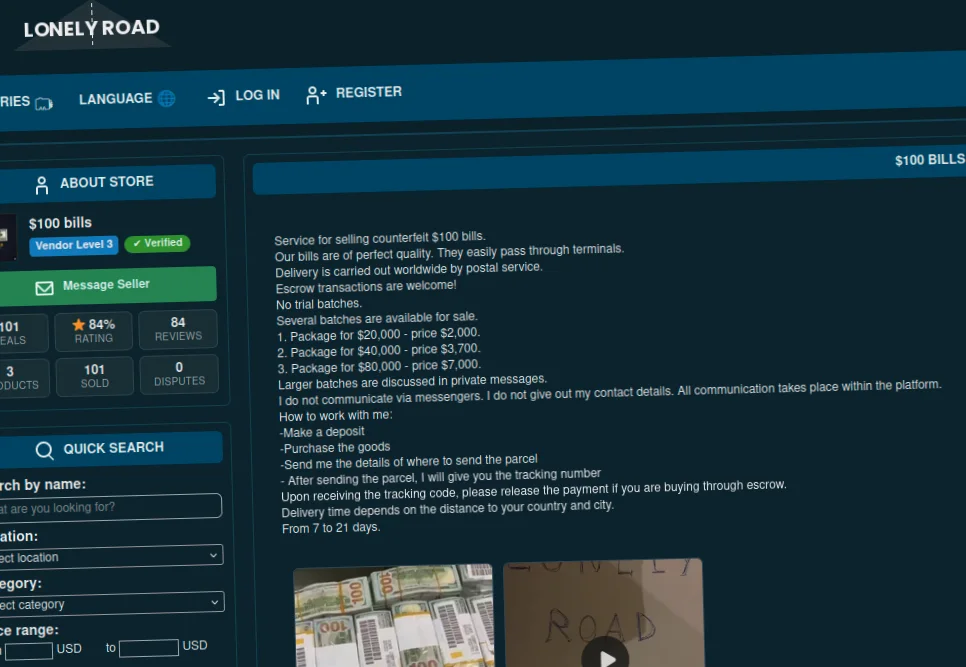
At 29 years old, Derek H. from Denver was convinced he had discovered a straightforward way to make money in the hidden corners of the internet, where unlawful activities flourish. A sum of $1,200 was put into cryptocurrency by a 29-year-old individual named Derek H., who aimed to acquire 40 counterfeit $100 bills from a vendor on the dark web. This vendor asserted that the bills were of exceptional quality, featuring elements designed to fool the public, including UV protection, magnetic strips, and watermarks that mimic authentic currency.
Derek's strategy was to insert these counterfeit notes into ATMs that accept cash, aiming to boost his digital balance before making withdrawals of legitimate money. This method appeared uncomplicated, much like attempting to present a fake ticket to an inattentive conductor in a busy station. However, the outcome was far from his expectations, as the reality of the situation unfolded differently than he had envisioned.
Derek ordered the notes from a darknet marketplace in January 2025.
The Purchase and Initial Success
Derek made a purchase of counterfeit notes from a darknet marketplace in January 2025. The $100 bills from the 2009 series arrived as expected, each crafted to pass visual inspections. His objective was straightforward: deposit these notes into an ATM to convert them into usable funds.
At first, the process went seamlessly; two ATMs accepted the bills, adding $800 to his balance. Everything seemed to be functioning well up to this point. However, issues began to emerge.
This is applicable only under the condition that the machines are not highly advanced; complications arise once modern verification systems are in operation. The third ATM outright rejected one bill with an error notification. The fourth machine accepted another bill but flagged the transaction for review. By the next day, the bank had completely frozen his account.
How Detection Occurred
The bank's fraud investigation team scrutinised the flagged transactions and discovered discrepancies in the magnetic strips and watermarks that typical scanners eventually detected. Approximately three weeks following these deposits, Derek was apprehended by law enforcement at his home in Denver, Colorado.
What initiated as an effort to circulate counterfeit currency concluded with prompt intervention from the authorities. This entire sequence transpired within a month, encompassing the acquisition in early January 2025 and concluding with the arrest by late January or early February. Following the account freeze, no funds could be accessed, leaving Derek without both the counterfeit money and any potential gain.
Similar detection challenges arise with other denominations. Individuals attempting to purchase counterfeit 20 dollar bills often encounter comparable risks of detection once the notes exit the initial online marketplace.
Why Such Schemes Collapse
The case demonstrates that even high-quality fake 100 dollar note batches carry substantial risk when introduced into the banking system. Modern ATMs and back-end verification routinely identify counterfeit $100 dollar bill forgeries that once might have passed. Those exploring buy fake dollars options or searching for a fake money site should recognise that law enforcement monitors these flows closely.
Prices vary across darknet vendors, yet the fake dollar price rarely reflects the true cost once arrest and legal consequences arrive. Whether considering 100 dollar fake money, counterfeit $20 dollar bills, or prop money dollars, the practical outcome remains the same: detection is likely and the scheme collapses. The Secret Service’s rapid response in Derek’s case serves as a clear illustration that these ventures seldom end as planned.
Common questions
How much did Derek pay for the fake money on the darknet?
Derek paid $1,200 in cryptocurrency for a batch of 40 counterfeit $100 bills. The seller advertised them as superdollar quality with UV protection, magnetic strip, and watermark intact.
What happened when Derek tried to deposit the counterfeit $100 dollar bill notes?
The first two ATMs credited $800 without issue. The third machine returned a bill with an error and the fourth flagged the deposit for review. The bank froze his account the next morning.
Which agency arrested Derek and when?
The U.S. Secret Service arrested him three weeks after the deposits. The events took place in Denver, Colorado, following his purchase in January 2025.
Can realistic fake money australia or buy counterfeit 20 dollar bills avoid detection?
Even advanced counterfeits face high detection risk once fed into modern banking systems. The same verification that caught Derek’s fake money dollar bills applies across denominations and geographies.
Sources
- 1
- Glowing reviews tout counterfeit cash on the dark web - Los Angeles Times
- 2
- Police swoop on suspected darknet fake banknote buyers - BBC News
- 3
- A counterfeit currency vendor on the darknet – Dark matters
- 4
- Dark Web Vendor of Opioids and Counterfeit U.S. Currency Pleads Guilty | United States Secret Service
- 5
- Europe’s second-largest counterfeit currency network on the dark web taken down in Portugal | Europol